We've been trying to find the most fitting way of introducing My Bookshelf readers to our newest site, My Music. Lo and behold, the perfect answer fell into our laps. Here, in a joint-feature with My Music, is the best song ever written! (okay, slight exaggeration, but it's fantastic and wonderfully literarily dorky).
Showing posts with label Harry Potter. Show all posts
Showing posts with label Harry Potter. Show all posts
Tuesday, July 5, 2011

Friday, August 6, 2010
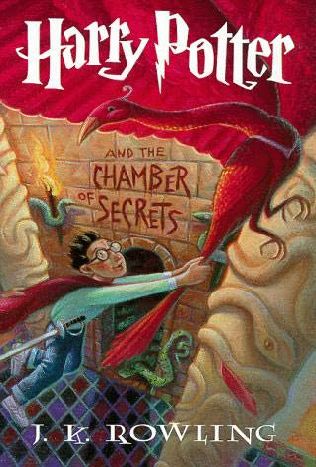
Harry Potter and the Chamber of Secrets
By Rachael
 I think there's a good subset of fans who consider Chamber of Secrets the weakest of the series. I have always been a part of this group. So it was with a mixture of determination and resolve that I approached re-reading the second book as part of my quest to re-read the whole series and record the experience.
I suppose this is where I should say, "However, on re-reading I found it was actually much better than I anticipated." To an extent I did find that, but the truth is that after re-reading Number 2, it's still my least favorite. My old stand by complaints are still there. I'm going to give them a little space here, before I move into what works.
My biggest issue in re-reading 2 is the feeling that if the whole series had been like Chamber of Secrets not only would the series have never reached the heights that it once did, it probably would have failed to even hold my interest. The action is common place, and not particularly complex. The threat isn't particularly well established (even once Hermione ends up petrified, there's not a real sense of loss. Compare that with Mr. Weasley in Book 5, and it's almost overwhelming how much better Rowling gets at upping the emotional stakes), the mystery (although mysterious) isn't that engaging, and the sense of Hogwarts, so essential to fleshing out the later books, isn't there yet. In fact, in Book 2 Harry Potter feels like any other children's fantasy book, and not like a multi-trillion dollar phenomenon totally deserving of all its hype.
In a lot of ways, Chamber just rehashes the plot structure of book one in a way that is far more formulaic than any subsequent books. Harry comes to school after fussing with the Dursleys, he settles into his life, he struggles in school, excels in Quidditch (but doesn't win), there's a threat that lurks by the edge of the action (but we're fairly certain won't appear until final exams), about halfway through half the student body turns against Harry and his friends, and in the end Dumbledore is sent away and Harry has to face the danger by himself. In fact, it's these predictable rhythms that probably helped to pull young readers in and prepare them to deal with the by-far-m0re-complicated later stories, but in re-reading it as an adult, it makes the stories feel a bit too pat.
The other problem with the book is Harry himself. In book 2, he's still a perfect, blank protagonist child. He rarely does anything for reasons other than noble ones, and although he makes mistakes, they're understandable mistakes. In other words, he doesn't feel like a real kid yet. He doesn't have his own, complicated internal thought process. He's perfectly linear. He's too one dimensional.
But... and you knew this was coming... HP 2 is also a lot better than I ever gave it credit for. It sets up plot points and themes that will only come into fruition three, four and five books later (that's right, Horcruxes, pensieves, Tom Riddle's family history, Lucius Malfoy as death eater). Rowling is already a master plotter, and the overall books' plots are already moving strong (much stronger than you could possibly know, just having read Book 2).
And even though I say that it's definitely the weakest of the books, that's not saying much. It's a lot like most children's literature, and I love children's lit. Book 2 is probably deserving of more respect than it gets, but coming before the PHENOMENAL Book 3 (my favorite, by the by) it's hard not to think of it as a stop gap before Rowling got into the good stuff.
 I think there's a good subset of fans who consider Chamber of Secrets the weakest of the series. I have always been a part of this group. So it was with a mixture of determination and resolve that I approached re-reading the second book as part of my quest to re-read the whole series and record the experience.
I suppose this is where I should say, "However, on re-reading I found it was actually much better than I anticipated." To an extent I did find that, but the truth is that after re-reading Number 2, it's still my least favorite. My old stand by complaints are still there. I'm going to give them a little space here, before I move into what works.
My biggest issue in re-reading 2 is the feeling that if the whole series had been like Chamber of Secrets not only would the series have never reached the heights that it once did, it probably would have failed to even hold my interest. The action is common place, and not particularly complex. The threat isn't particularly well established (even once Hermione ends up petrified, there's not a real sense of loss. Compare that with Mr. Weasley in Book 5, and it's almost overwhelming how much better Rowling gets at upping the emotional stakes), the mystery (although mysterious) isn't that engaging, and the sense of Hogwarts, so essential to fleshing out the later books, isn't there yet. In fact, in Book 2 Harry Potter feels like any other children's fantasy book, and not like a multi-trillion dollar phenomenon totally deserving of all its hype.
In a lot of ways, Chamber just rehashes the plot structure of book one in a way that is far more formulaic than any subsequent books. Harry comes to school after fussing with the Dursleys, he settles into his life, he struggles in school, excels in Quidditch (but doesn't win), there's a threat that lurks by the edge of the action (but we're fairly certain won't appear until final exams), about halfway through half the student body turns against Harry and his friends, and in the end Dumbledore is sent away and Harry has to face the danger by himself. In fact, it's these predictable rhythms that probably helped to pull young readers in and prepare them to deal with the by-far-m0re-complicated later stories, but in re-reading it as an adult, it makes the stories feel a bit too pat.
The other problem with the book is Harry himself. In book 2, he's still a perfect, blank protagonist child. He rarely does anything for reasons other than noble ones, and although he makes mistakes, they're understandable mistakes. In other words, he doesn't feel like a real kid yet. He doesn't have his own, complicated internal thought process. He's perfectly linear. He's too one dimensional.
But... and you knew this was coming... HP 2 is also a lot better than I ever gave it credit for. It sets up plot points and themes that will only come into fruition three, four and five books later (that's right, Horcruxes, pensieves, Tom Riddle's family history, Lucius Malfoy as death eater). Rowling is already a master plotter, and the overall books' plots are already moving strong (much stronger than you could possibly know, just having read Book 2).
And even though I say that it's definitely the weakest of the books, that's not saying much. It's a lot like most children's literature, and I love children's lit. Book 2 is probably deserving of more respect than it gets, but coming before the PHENOMENAL Book 3 (my favorite, by the by) it's hard not to think of it as a stop gap before Rowling got into the good stuff.
Wednesday, July 21, 2010
Harry Potter and The Sorcerer's Stone
 By Rachael
Perhaps it seems redundant to you to read yet another article about Harry Potter, especially three years after the final book came out. However, one of the singular joys of being a Harry Potter fan for me has been the ability to revisit these books throughout my life and discover new and exciting things about them. I've never stopped experiencing the magical world of harry potter, even once new things stopped coming out.
Thus, when I was thinking about creating my first feature for My Bookshelf, I realized that I was already doing it: I decided this summer to (for the first time in an absurdly long time) delve back into the world JK Rowling created with a vengeance. Don't get me wrong, I've picked up the odd book or two throughout the years, but I haven't re-read them all start to finish for a long while. And in my first summer break as a teacher, I decided nothing could better fill my time.
So here's my reflections (there's no point in pretending I'm going to review these books) on Harry Potter and The Sorcerer's Stone:
For one thing, I'd forgotten how good that story is. It has an almost perfect arch, bringing Harry from clueless orphan to confused adolescent. The introductions of Ron and Hermione are surprisingly seamless as well. In fact, the most remarkable thing about the first book is realizing just how well realized this world already was. Without a single mention of either hallows or horcruxes, Rowling has effectively established the world where these life changing entities exist, but has filtered it through the severely limited understanding of the 11 year old protagonist who leads the books.
I'm not interested in recounting the plot; between the movies, books, and overall popular culture phenomenon-ness of Harry Potter, you either already know the plot or don't care. And I'm not super involved in the themes yet (those will almost certainly come up later). What I'm most amazed at in re-reading the first book is the feeling of possibility, an in feeling almost overwhelmed by how well these books turned out. Although, as I've said, I actually think the inaugural effort is very good and that retrospectively speaking its easy to see the characterization, thematic control, and plotting that would come to define Harry Potter as a series, it's also just as easy to see that this book could have been nothing. I stare at the goofy cover art, now as dear to me as a beloved childhood toy, and think, "This doesn't scream multi-billion dollars." Or I read the adorably sincere dedication from Rowling to her daughter and the other two women who helped her along the way, and I realize how tenous it all was.
It all fills me with an enormous sense of... kizmet, I guess. And in a way it all ties back into Dumbledore's final speech about how Choice, not Destiny determines our Fate. These books, in my opinion, took the right choices every step of the way.
Not every book reflection is going to be so laudatory, but the first book really just feels like this time capsule back to the moment when I first felt these books in my hands. I certainly didn't know that I was starting an obsession that would come to define some of the most important moments in my life, that would be my consolation in the tough times, and a favorite recreation during the good times. It was just a present. On my 11th birthday, I opened the front cover to a handwritten inscription that said, "Rachael- if there was ever a movie version of this, we could see you playing Hermione. Love you." And I remember being OFFENDED, while reading, to think that I could play this annoying, shrewish little girl. But much like Ronald Weasley, I came to love her, and the books that contained her, in all their poofy-haired, magical glory.
Subscribe to:
Posts (Atom)

 Posts
Posts

