If there's one thing we've learned from Hunger Games fever it's that YA readers were desperate to move on from the Bella Swan heroine model. Feminists, hipsters and tween girls alike have flocked to the stubbornly flawed but undeniably kickass Katniss Everdeen like she was a breath of fresh air; which, after years of a Twilight-ruled landscape, she was. But for vampire lit fans, a suitably strong leading lady has been sadly harder to find (they're out there, they're just not as famous). So we thought we'd help you out, point you towards our favourite cast of smart and capable girls living in a young adult fantasy world (yes, a whole cast of them). Actually, come to think of it, we've been missing some great heroes too; of the un-dead but still non-creepy variety, that is (and some living ones thrown in for good measure). And deep mythology with a sense of history and tradition, building a distinct world and a new kind of lore on top of the existing myths . And fun narrative voices with just enough self-aware snark to overcome some of the genre's sillier tropes. Oh I give up, there's all sorts of goodness in Alyxandra Harvey's teen vampire series The Drake Chronicles, I'm not going to bother choosing an angle.
Each book in the 6-part series (book 4 comes out in North America this month, it's already out in the UK) is narrated by a pair or trio of different characters from Harvey's well-populated world and explores the action of a dramatic couple weeks in the fictional town of Violet Hill from a new perspective.
Showing posts with label Review. Show all posts
Monday, December 5, 2011
Monday, November 7, 2011
Heroes of Olympus: The Son of Neptune
by Rachael Nisenkier
I am too old for Percy Jackson. I’m okay with that. But I think it’s important to start off this review with a qualification: Percy Jackson is not Harry Potter, it’s not the The Hunger Games, it’s not even Twilight. Which is to say, it’s not a careful examination of adult themes through the guise of children’s literature.
What Percy Jackson is, to use a slightly awkward sentence construction, is a truly awesome adventure story whose self-contained mythology draws heavily on Greek and Roman myths while providing often funny modern touches. On top of that, author Rick Riordan has created believable teenage characters who just happen to have the powers of greek or roman gods.
Saturday, September 17, 2011
Book Flashback: Good Omens
This feature sees your intrepid author venturing back into the books that delighted her in the past to see if they still stand up.
by Rachael Nisenkier
If you're a fantasy reader, chances are good that you've heard of Neil Gaiman and Terry Pratchett. In fact, I think I'd be willing to say chances are about 100% that you've heard of at least one of them. Otherwise, you've probably never read a fantasy book outside of Harry Potter or Twilight, and regardless of either book's relative merits*, you're not a real reader of fantasy so much as a reader of immensly popular book series.
Anyway, Neil Gaiman has made a living being the unfathomably cool poster boy for the legitimacy of fantasy and comics being "art." From his 1980s/early 90s graphic novel revolution in the form of The Sandman, to his 2002 opus/deconstructing of the modern religious psyche American Gods, Gaiman continually manages to maintain the literature part of fantasy literature, and, despite his massive success, still seem like a James Dean-type British outsider creating his hip art inside a dangerous and insightful medium (PLUS, he wrote an episode of Doctor Who!).
Terry Pratchett is slightly more niche, but to fans of fantasy (and specifically, to fans of satirical fantasy the likes of which hasn't been seen since Douglas Adams) he is a irreplaceable part of the landscape. His DiscWorld novels span topics from sexism to racism to nationalism to Trolls, and contain over 39 books. If Gaiman is the leather jacket wearing cover boy of modern fantasy, Pratchett is the hilarious and cutting stand up comedian who warms up the crowd for him.
But back in the mid 1980s when they started working on their collaboration (as Gaiman puts it in his foreword, before there even was a "Neil Gaiman" and a "Terry Pratchett" for them to be), they were just two struggling writers who happened to get along pretty well. And so they wrote a book together about the end of the world, because if you were Neil Gaiman and Terry Pratchett, what would you do with your spare time?
I first picked up Good Omens my freshman year of high school. A much-smarter-than-me friend had been trying to convince me to read Neil Gaiman and Terry Pratchett for the better part of the year, and I, being the open-minded adventurer I was back in high school, was pretty resolute about saying no. But I've always been drawn to fantastical tales of good and evil, so when she put a copy of Good Omens in my hands I had to crack it. The cover itself was just so inviting.
In high school this set off a flurry of very expensive purchasing. I simply had to have every installment of the Sandman franchise (despite their $20-a-pop price, and the fact that I read them in about an hour, I refused to rent them from the library). My whole family began devouring Discworld (which, at about $8-a-pop, might seem a bargain, until you multiply that times THIRTY NINE). Every Neil Gaiman book was greeted with a mixture of trepidation and financial ruin.
So was this book actually as good as its effect on me in high school would imply? When I rescued my old, signed (BY BOTH AUTHORS, hachacha!) copy from a box of books my parents were trying to donate, I decided to investigate.
by Rachael Nisenkier
If you're a fantasy reader, chances are good that you've heard of Neil Gaiman and Terry Pratchett. In fact, I think I'd be willing to say chances are about 100% that you've heard of at least one of them. Otherwise, you've probably never read a fantasy book outside of Harry Potter or Twilight, and regardless of either book's relative merits*, you're not a real reader of fantasy so much as a reader of immensly popular book series.Anyway, Neil Gaiman has made a living being the unfathomably cool poster boy for the legitimacy of fantasy and comics being "art." From his 1980s/early 90s graphic novel revolution in the form of The Sandman, to his 2002 opus/deconstructing of the modern religious psyche American Gods, Gaiman continually manages to maintain the literature part of fantasy literature, and, despite his massive success, still seem like a James Dean-type British outsider creating his hip art inside a dangerous and insightful medium (PLUS, he wrote an episode of Doctor Who!).
Terry Pratchett is slightly more niche, but to fans of fantasy (and specifically, to fans of satirical fantasy the likes of which hasn't been seen since Douglas Adams) he is a irreplaceable part of the landscape. His DiscWorld novels span topics from sexism to racism to nationalism to Trolls, and contain over 39 books. If Gaiman is the leather jacket wearing cover boy of modern fantasy, Pratchett is the hilarious and cutting stand up comedian who warms up the crowd for him.
But back in the mid 1980s when they started working on their collaboration (as Gaiman puts it in his foreword, before there even was a "Neil Gaiman" and a "Terry Pratchett" for them to be), they were just two struggling writers who happened to get along pretty well. And so they wrote a book together about the end of the world, because if you were Neil Gaiman and Terry Pratchett, what would you do with your spare time?
I first picked up Good Omens my freshman year of high school. A much-smarter-than-me friend had been trying to convince me to read Neil Gaiman and Terry Pratchett for the better part of the year, and I, being the open-minded adventurer I was back in high school, was pretty resolute about saying no. But I've always been drawn to fantastical tales of good and evil, so when she put a copy of Good Omens in my hands I had to crack it. The cover itself was just so inviting.
In high school this set off a flurry of very expensive purchasing. I simply had to have every installment of the Sandman franchise (despite their $20-a-pop price, and the fact that I read them in about an hour, I refused to rent them from the library). My whole family began devouring Discworld (which, at about $8-a-pop, might seem a bargain, until you multiply that times THIRTY NINE). Every Neil Gaiman book was greeted with a mixture of trepidation and financial ruin.
So was this book actually as good as its effect on me in high school would imply? When I rescued my old, signed (BY BOTH AUTHORS, hachacha!) copy from a box of books my parents were trying to donate, I decided to investigate.
Monday, September 12, 2011
Adaptation Alert: One Day
by Kelly Bedard
The film adaptation of the truly wonderful book One Day, predictably, leaves much to be desired. While the presence of the always sensational Patricia Clarkson (perfectly cast in the pivotal role of Dexter’s idealized mother) certainly helped the film along, the incredible miscasting of the story’s leading lady proved devastating to the adaptation.
So much of the complication in Dexter and Emma’s relationship comes from their regional class differences. In casting an American actress (no matter how charming) without perfect accent skills, the filmmakers essentially robbed themselves of that crucial tool. Anne Hathaway could have given the performance of her life (which, for the record, she did not even come close to giving) and no one would have cared because her accent work was just so bad. It was inexcusable (though I will admit that no one pulls off an "awkward girl comes into her own" makeover quite like Hathaway).
Saturday, September 3, 2011
Rachael on Stephen King on Writing

by Rachael Nisenkier
It’s rare that you get to say a book changed your life and not be talking at least somewhat hyperbolically. It’s even rarer to get to say that about a book by Stephen King.
I’m not trying to knock the man whose name is ridiculously appropriate given that he is the King of pulp horror novels. It’s just that Stephen King doesn’t really put a lot of pretensions into his writing. He’s there to tell a good story, and tell it well. He doesn’t consider himself a great, life-changing writer. He is ambitious when it comes to the scope and breadth of his writing repertoire, but not in terms of the pretensions of the individual novels. And I’m sure he feels the same about the book about which I am here to talk, his 2000 memoir/writing guide On Writing. Nonetheless, On Writing changed my life. Twice.
Saturday, August 20, 2011
Ten Thoughts on "A Dance With Dragons"

(because an actual review would just be scattershot and hard to follow)
by Rachael Nisenkier
10. It turns out I really like the actual kingdom of Westeros. One of my problems with this installment was that most of the action was set in the southron kingdoms, like Meereen and Bravos, and that I wasn’t all that invested in the outcomes there.
9. God I missed Sansa. Who would have thought, back in book 1 when she was just a whiny spoiled rich girl, that she would become one of my favorite characters?
8. And speaking of surprising favorite characters, I love Theon Greyjoy. Not since Jamie went from incestuous kingslayer to charming defender of the Maid of Tarth has my opinion of a character so completely flipflopped.
7. Although I liked the book, I think it suffered even more than Feast for Crows by only having half the story. I’m looking forward to having all the action back together in the next book, whenever that comes out.
6. It was nice having Tyrion back, but the entire book kind of felt like it had a “How Tyrion Got His Groove Back” vibe, after the decimation of everything that led to him pulling out that crossbow on Tywin.
HERE BE SPOILERS
Monday, August 8, 2011
The Help
by Rachael Nisenkier
I am happy to admit I indulge in the time-honored tradition of hurrying to read a book before a movie comes out. I’d like to think that I DON’T do this just so I can sound smart and say things like, “Well, yes the movie portrays her angst in a very visual way, but it loses the book's subtlety in representing her ennui” (which, is, for the record, what I imagine to be a stupid thing to say about a book-turned-movie). I’d like to think that I do this because I love stories, and prefer to visualize them in my own head before I see them on screen. But it’s possible I’m just kind of a tool.
Anyway, in anticipation of the new Emma Stone vehicle that had me tearing up every time I saw the trailer, I decided to read The Help. I’m a sucker for southern-fried racism stories, and enjoy a good "plucky women overcome stereotypes" yarn. So, in my summer-induced boredom, I plunked my behind down in the middle of Barnes and Noble and started reading.
Six hours later (yes, I sat on the floor of a Barnes and Noble for six hours, I don’t have a real job-screw you), I closed the book. In a summer filled with epic fantasy, this simple tale of three different women figuring out the central thesis that underneath our skin color we’re all just people had me epically gripped.
I am happy to admit I indulge in the time-honored tradition of hurrying to read a book before a movie comes out. I’d like to think that I DON’T do this just so I can sound smart and say things like, “Well, yes the movie portrays her angst in a very visual way, but it loses the book's subtlety in representing her ennui” (which, is, for the record, what I imagine to be a stupid thing to say about a book-turned-movie). I’d like to think that I do this because I love stories, and prefer to visualize them in my own head before I see them on screen. But it’s possible I’m just kind of a tool.
Anyway, in anticipation of the new Emma Stone vehicle that had me tearing up every time I saw the trailer, I decided to read The Help. I’m a sucker for southern-fried racism stories, and enjoy a good "plucky women overcome stereotypes" yarn. So, in my summer-induced boredom, I plunked my behind down in the middle of Barnes and Noble and started reading.
Six hours later (yes, I sat on the floor of a Barnes and Noble for six hours, I don’t have a real job-screw you), I closed the book. In a summer filled with epic fantasy, this simple tale of three different women figuring out the central thesis that underneath our skin color we’re all just people had me epically gripped.
Sunday, July 24, 2011
A Dance with Dragons, Interrupted
![]() |
This picture represents how I feel right now about the newest Song of Ice and Fire book: burnt, terrified, and kind of excited that there’s a dragon on my shoulder. |
Rachael, you say, after post after post in breathless anticipation of A Dance With Dragons, how is it possible that you’ve yet to say anything about the latest in George R. R. Martin's saga?
Well, hypothetical internet reader, I am ashamed to report that my radio silence comes from a rather pathetic place: I haven’t finished it yet. I was the girl who prided herself on finishing Harry Potter first in a house full of speed readers. And yet now here I sit, almost two weeks out from the release of A Dance With Dragons, and I’m on page 370?
Friday, July 15, 2011
City of the Ick Factor
by Rachael NisenkierOne of the unfortunate side effects to being addicted to young adult literature, particularly of the Sci Fi-Fantasy variety is you occasionally get sucked into a story that the whole time makes you feel like a fool. Lots of YA Lit is great, well-written stuff. But a lot of it (like any genre) is boring, or derivative, or weird. Or all of the above. Facing 16 hours in the car, I chose the audio book City of Bones by Cassandra Clare. This is one of those YA books with a really cool cover that normally shares a table with The Hunger Games and Twilight, so you can assume it’s pretty popular. Plus, it seemed like a pretty cool premise: otherwise ordinary-seeming Clary discovers a vast world of shadow hunters (basically, people with the same job as Sam and Dean on Supernatural), demons, underworlders, and deception and realizes, to her surprise, that she is an intricate part of this world. Okay, I’m with you. Add to that a nerdish best friend named Simon and a tantalizing bad boy demon hunter named Jace, and I was pretty much sold. And the issue with the book is not the plot (with one VERY large exception, which I’ll get to in the SPOILERS section).
Tuesday, July 5, 2011
Quick Hits: Memoir Edition
by Rachael Nisenkier
I have a passion for both memoirs and religious stories, so it seemed like Mennonite in a Little Black Dress was written for me. Yet the overall narrative left me cold.
The author, Rhoda Janzen, has had an interesting and occasionally tragic life. And she chronicles it all with a humor and good cheer that really helps to pull the reader in. But the book loses steam as she goes off on tangents and random anecdotes while living back in her parents' Mennonite community.
Janzen is at her best when chronicling the absurd or the melodramatic moments in her life, yet without a clear through-line in her narrative, the book left me feeling unfulfilled.
I have a passion for both memoirs and religious stories, so it seemed like Mennonite in a Little Black Dress was written for me. Yet the overall narrative left me cold.
The author, Rhoda Janzen, has had an interesting and occasionally tragic life. And she chronicles it all with a humor and good cheer that really helps to pull the reader in. But the book loses steam as she goes off on tangents and random anecdotes while living back in her parents' Mennonite community.Janzen is at her best when chronicling the absurd or the melodramatic moments in her life, yet without a clear through-line in her narrative, the book left me feeling unfulfilled.
Monday, June 20, 2011
MyBookshelf: Quick Hits

Welcome to a new recurring feature over here at MyBookshelf. Quick Hits is a monthly feature that will allow us at MyBookshelf to share a little bit about some books that we love, whether they be classic favorites or new discoveries. Rather than providing long reviews, these quick hits will give you just a little taste of the books before sending you over to Amazon.com to check out the books more in depth.
Read on for our first edition of Quick Hits
Tuesday, January 11, 2011
This Rough Magic
The longest-tenured Artistic Director in the history of The Stratford Shakespeare Festival was an eccentric former actor famous for temper tantrums and stage fright. As a director, he staged some of the most popular productions the festival ever housed. In his 14 seasons in charge, he opened the new studio theatre, started the Birmingham conservatory and brought the festival completely out of the red.
This Rough Magic tells the story of how Richard Monette got there.
If you can make it through the somewhat tedious early years account, the material reading almost as an excuse for any bratty behaviour that might follow, the memoir quickly becomes a deliciously interesting read. For any theatre buff, and especially Stratford patrons, This Rough Magic is a fascinating first-person account of the life of one of the festival's most intriguing personalities.
From his 19-year-old performance as Hamlet through his breakout role in Michel Tremblay's Hosanna to his diva-esque quest for the part of Romeo and his decision to briefly trade in Shakespeare to perform naked in the original cast of Oh! Calcutta!, Monette gets down to the nitty gritty details of his life in the theatre, whether it makes him look good or not.
Telling the tragic story of his love affair with the recently-deceased Domini Blythe, his subsequent coming out of the closet and the lonely years that followed- the memoir is, at times, a very touching human story. At others, it is a rambunctious tale of a narcissistic megalomaniac who often seems to have been much of the inspiration for the character of crazypants Darren Nichols in the television show based on the festival, Slings and Arrows.
Intimate stories populated by legends like William Hutt and Maggie Smith fill many of the pages, including the account of his first moments on the world-famous festival stage when Hutt, often considered the greatest actor in national history, greeted him with the words "welcome home".
The more you know and love the festival the more fascinating this book becomes. The more you know about classical theatre, the faster you'll want to turn the pages. But for any theatre fan at all, This Rough Magic is truly a memoir not to be missed.
This Rough Magic tells the story of how Richard Monette got there.
If you can make it through the somewhat tedious early years account, the material reading almost as an excuse for any bratty behaviour that might follow, the memoir quickly becomes a deliciously interesting read. For any theatre buff, and especially Stratford patrons, This Rough Magic is a fascinating first-person account of the life of one of the festival's most intriguing personalities.
From his 19-year-old performance as Hamlet through his breakout role in Michel Tremblay's Hosanna to his diva-esque quest for the part of Romeo and his decision to briefly trade in Shakespeare to perform naked in the original cast of Oh! Calcutta!, Monette gets down to the nitty gritty details of his life in the theatre, whether it makes him look good or not.
Telling the tragic story of his love affair with the recently-deceased Domini Blythe, his subsequent coming out of the closet and the lonely years that followed- the memoir is, at times, a very touching human story. At others, it is a rambunctious tale of a narcissistic megalomaniac who often seems to have been much of the inspiration for the character of crazypants Darren Nichols in the television show based on the festival, Slings and Arrows.
Intimate stories populated by legends like William Hutt and Maggie Smith fill many of the pages, including the account of his first moments on the world-famous festival stage when Hutt, often considered the greatest actor in national history, greeted him with the words "welcome home".
The more you know and love the festival the more fascinating this book becomes. The more you know about classical theatre, the faster you'll want to turn the pages. But for any theatre fan at all, This Rough Magic is truly a memoir not to be missed.
Tuesday, December 21, 2010
One Day
One of the year's most successful literary offerings, One Day by David Nicholls is so much more than chick lit. The story of Emma and Dexter is hilarious, heartbreaking, poignant and inescapably honest. It also sports a truly excellent structure, dropping in on Em and Dex once a year from 1988 to 2006. The one day structure allows for an interesting ambiguity as we miss many of the big moments in their lives, dropping in, instead on July 15th every year, the anniversary of their meeting. Sometimes that day is an exceptionally important one (a wedding, a vacation, a fight, a death) and sometimes it's a boring glimpse into lives stuck in depressing limbos (Mexican restaurants, tedious social scenes, dead-end relationships). And oftentimes, it's those boring moments that tell us the most.
The story of Emma and Dexter is wonderfully complicated, a relationship too complex for easy description. They're romantic, but not always, in love, in hate, in all sorts of things, but for the most part, they're best friends. There's a point near the end of the novel when Emma says that her and Dex "grew up together", though they met when they were 22. It's a story about growing up and learning who you are and having someone to lean on.
One Day has romance, comedy, tears, laughter and everything in between but the sum is truly worth more than its parts.
The story of Emma and Dexter is wonderfully complicated, a relationship too complex for easy description. They're romantic, but not always, in love, in hate, in all sorts of things, but for the most part, they're best friends. There's a point near the end of the novel when Emma says that her and Dex "grew up together", though they met when they were 22. It's a story about growing up and learning who you are and having someone to lean on.
One Day has romance, comedy, tears, laughter and everything in between but the sum is truly worth more than its parts.
Sunday, October 31, 2010
What Happens When You Venture Outside of Young Adult Fiction
Now, strolling through the aisles of the bookstore equivalent to Walmart is a slightly less epic affair, but it's none the less one of my favorite activities. The rows upon rows of carefully arranged books still call out to me. And I love those days when I stumble upon something in the middle of my walk that is at once surprising and overwhelming.
So was the case when earlier today I picked up a book titled The New York Regional Mormon Singles Halloween Dance. The book had no dragons on it, nor any hint that there would be vampires in the story, and I couldn't even decisively say if it would have a headstrong female protagonist, but the book did have one thing that always calls to me: the tale of a religious person dealing with the modern world.
I don't know why religion facinates me as much as it does. Maybe it's something freudian, like I never got religion as a kid so now as an adult I crave that sort of stability. Or maybe it's that after being raised on a steady diet of fantasy novels and Joss Whedon shows, I refuse to believe that there's nothing more to life than the blood pumping under my skin. Phillip Pullman would be so ashamed.
Whatever the reason, I have an odd fascination with relgious memoirs. And this one was a doozy: singleton Elna Baker finds herself a twenty-something, virgin, 250 lbs Mormon living in the middle of New York, den of sin. Throughout the course of the book she dates an atheist, loses 80 lbs, gets plastic surgery, almost dies, and thinks a lot. But none of that really captures the feeling of reading Baker's memoir.
The thing is, she's just such a refreshing voice, straight forward and straight laced, restrained yet honest. She's a mormon, a faith that most Americans put third in terms of "crazy pants" right behind Scientology and Raptorism*. It's a religion that definitely gets a bad rap, not least because of the "golden cutlery" and polygamy reputation that the Joseph Smith's flock just can't seem to shake. And Elna is very much so a person of our world, someone who's first college roommate was a lesbian who routinely left out her strap on and who has made out with a 60+ celebrity in a bar. This contrast drives the novel.
The book, and Elna herself, refuses to be pigeon holed. Mormonism is a huge part of Elna's life, and it has been throughout her life a huge source of strength and goodwill. She describes feeling at peace with God and believing in the sacraments of her faith in a way that will undoubtedly make many people uncomfortable. But the brilliance of the book, and the reason why Baker's is such a unique voice, is that it makes her uncomfortable too. She refuses to lock her faith in the closet, as it were, but she also can't stop herself from examining it in the light.
Which is to say nothing of how damn funny the book is, or how endearing Elna was, or how many parts of the story I could relate to, despite not being a young Mormon girl trying to make it in New York City. The quotes on the back of the book make it seem like some publishers wet dream, "CARRIE BRADSHAW MEETS MORMONISM!" but the truth is far less simplistic. The New York Regional Mormon Singles Halloween Dance is more David Sedaris meets Christopher Hitchens meets On The Road meets Eat Pray Love meets St. Augustine's Confessions.
In other words, the book refuses to pick a path and stay on it, and I wouldn't have it any other way.
*A religion I just made up that states that we all came from raptors, like the Koopa people in the feature length version of Super Mario Brothers with John Leguizamo and Dennis Hopper.
Tuesday, October 5, 2010
The Knife of Never Letting Go
Still, it's rare that a book makes me rethink what books can do. The Hunger Games series was like that. It picked me up from my daily stupor and shook me and made me rethink everything. Coming so soon after finishing that series, I've recently been reading books more with an outlook of: well, I dont have TV yet, so I might as well read something fun.
Then I picked up The Knife of Never Letting Go. And it picked me up and shook me out and left my dazed, confused, and desperate for the next book.
I'm not going to go into a lot of detail, but here's a ridiculously brief summary: The Knife of Never Letting Go tells the story of Todd, a young man living in Prentisstown on a foreign world that is western-influenced. Prentisstown is not like other towns; for one thing everyone can hear everyone else's thoughts (and all the animals can talk). Which sounds adorable, until we get to the second part: there are no women in Prentisstown, and the people there hold horrible, unfathomable secrets that they work hard to cover up. The sounds of men filter together into an overwhelming and mostly indecipherable omnipresent "noise," which in Prentisstown is a horrible mix of sound and pictures and hatred. When Todd discovers something abnormal in the swamp as he approaches his all-important 13th birthday, he has to run from Prentisstown, along the way discovering why exactly his world is so damn messed up.
That doesn't even begin to cover what The Knife of Never Letting Go is about, but half the beauty of the book is in trying to untangle the books ample metaphors and mysteries. On top of that, the unique stylistic voice of the book is constantly engaging and unique.
It starts to lose some steam near the end, and the ending isn't as satisfying as you will want it to be, but The Knife of Never Letting Go is something so much more than all that: freaking mind boggling. From the beginning to the end of the book, I was glued to the pages, and thinking the entire time (which, to be honest, is a lot to ask of me of late).
It's more than worth it, it's practically neccessary reading for fans of quality young adult ficiton.
Monday, September 13, 2010
Mockingjay
It's taken me just under a month to post on Mockingjay, the final installment of Suzanne Collins unparalleled trilogy, after having finished it. It wasn't for lack of passion. But although I may have consumed the novel like a cheeseburger after a Yom Kippur, I wanted to let it slowly ruminate in my mind for the past month, letting the themes and images that characterized Katniss Everdeen's final chapter run around in my head before I started expounding on it.
First, a quick summary. Katniss Everdeen, in book 1 of the Hunger Games, was caught up by her dystopian government in their ploy to keep the poor districts they controlled in line. She became a "tribute" in the Hunger Games, which required a girl and a boy from each district to compete to the death for the amusement of those in the rich Capital. She and Peeta, a young man whose fate has been entwined with hers since her father first died in a mining accident, survive together against all odds.
The second book saw Katniss Everdeen once again unable to control her fate. The spark of her survival has set off a blaze of revolution, and the Capital once again attempts to control Katniss and control the people. It doesn't work.
The first two novels in the Hunger Games series were two of the most captivating, entrenching, and fascinating books I've ever read. I took them in at lightning fast speed, and devoured every moment of the story. Katniss was a character for the ages, and Peeta was one of the most endearing nice guys ever created. On top of that, the plots were always twisty and turny, fascinating and plausible.
Despite how beloved the first two books were for me, I was unprepared for Mockingjay, a book that I actually think improves upon the previous two. Gone is the straight forward action/romance of the first two (although there's plenty of that, more on this later), replaced by a morally ambiguous, surprisingly dark look at human nature and the cost of war.
In Mockingjay, Katniss is once again seen as an object to be controlled. She and Peeta throughout this series have attempted to maintain their sense of identity in the face of unknowable power. There's a particularly strong moment in book 1 where Peeta expresses his desire to show the capital that they can't make him be someone he's not. In this last book, that idea of self is pushed to the max. Both Peeta and Katniss are used as objects, and it is in their quest to be more than the sum of their experiences or the result of actions upon them that the book finds its particular thematic resonance.
On top of that, the book reaches a sense of morality and futility that few children's books ever have encapsulated. When Katniss is rescued at the end of Book 2, and brought to the thought-dead colony of District 13, it was tempting to think of it as salvation. But Collins is not content with the story of one little girl taking on the Goliath of her own civilization. This isn't a straight-out hero story. And this takes it to an unusual place, where instead of the rise and fall, tension and climax of traditional fantasy stories, we have Katniss grappling with the inevitable tendency of power to corrupt. Although District 13 may be preferable to life under The Capital, it's a dystopian nightmare of its own. And while The Capital may make for slovenly shallow people who were content to watch children kill each other for their amusement, it also creates people capable of unfathomable beauty and kindness, and all of that is worth preserving.
In the end, Katniss and the readers are left with an indelible sense that the world is far more complex and infuriating than we can understand. Katniss suffers loss so heavy she seems incapable of moving beneath it. The readers, similarly, lose all sense of human value as we watch everything we've taken for granted get stripped away. Collins is never afraid of portraying the inevitability of death nor the fallibility of all of our beloved characters.
But the novel isn't all dark. The love story, which about halfway through Mockingjay starts to seem a bit dragged out, keeps the tone from ever getting too bleak (until the very end) and the legitimate sense of love and kindness that pervades the novel makes the depressed-but-still-hopeful ending feel deserved. As the reader, you've gone through hell along with Katniss. But Collins makes you believe in the smallness of victory of the human spirit. Power may corrupt, systems may fall, and people may die, but life goes on and has beauty.
The biggest problem for me in so many examples of Young Adult fiction is the distinct lack of consequences. In order to make an ending swallowable for a young audience, far too many writers feel the need to wrap things up neatly. I don't always mean Twilight-style, everyone is happy if wicked creepy for falling in love with a baby style endings, but it can be as simple as killing off one love interest in the hopes of making a heroin's choice for her. Or leaving her with a tangible sense of home to go back to. Katniss is not allowed these cheats; the true costs of what society and her life have come to are in full force. And this makes the story far more adult than would be easy.
In the end, the story is best summed up with a metaphor Collins herself creates for us at the end of the journey. Katniss, broken and beaten, wanted for murder and wanting for nothing, alone and hopeless, stumbles over the ruins of District 12, which was once her home. In the vast emptiness and rubble, she hears familiar footfalls. It's not Peeta, the boy who saved her life in the arena, or Gale, the childhood friend who loves her, but her sister's ugly, angry, survivor of a cat. Their whole lives together have been a battle, a battle for attention, for food, for affection. They've hated each other, hurt each other, resented each other. Yet as Katniss, the girl who was on fire, slowly nurses her burns (both physical and emotional) and gets back to health at the end of the novel, it is the love, support and protection of this embattled feline that surrounds her, and gives both her and us hope that love can survive and is worth the battle.
Friday, August 6, 2010
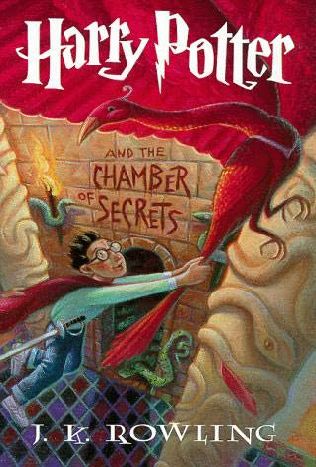
Harry Potter and the Chamber of Secrets
By Rachael
I think there's a good subset of fans who consider Chamber of Secrets the weakest of the series. I have always been a part of this group. So it was with a mixture of determination and resolve that I approached re-reading the second book as part of my quest to re-read the whole series and record the experience.
I suppose this is where I should say, "However, on re-reading I found it was actually much better than I anticipated." To an extent I did find that, but the truth is that after re-reading Number 2, it's still my least favorite. My old stand by complaints are still there. I'm going to give them a little space here, before I move into what works.
My biggest issue in re-reading 2 is the feeling that if the whole series had been like Chamber of Secrets not only would the series have never reached the heights that it once did, it probably would have failed to even hold my interest. The action is common place, and not particularly complex. The threat isn't particularly well established (even once Hermione ends up petrified, there's not a real sense of loss. Compare that with Mr. Weasley in Book 5, and it's almost overwhelming how much better Rowling gets at upping the emotional stakes), the mystery (although mysterious) isn't that engaging, and the sense of Hogwarts, so essential to fleshing out the later books, isn't there yet. In fact, in Book 2 Harry Potter feels like any other children's fantasy book, and not like a multi-trillion dollar phenomenon totally deserving of all its hype.
In a lot of ways, Chamber just rehashes the plot structure of book one in a way that is far more formulaic than any subsequent books. Harry comes to school after fussing with the Dursleys, he settles into his life, he struggles in school, excels in Quidditch (but doesn't win), there's a threat that lurks by the edge of the action (but we're fairly certain won't appear until final exams), about halfway through half the student body turns against Harry and his friends, and in the end Dumbledore is sent away and Harry has to face the danger by himself. In fact, it's these predictable rhythms that probably helped to pull young readers in and prepare them to deal with the by-far-m0re-complicated later stories, but in re-reading it as an adult, it makes the stories feel a bit too pat.
The other problem with the book is Harry himself. In book 2, he's still a perfect, blank protagonist child. He rarely does anything for reasons other than noble ones, and although he makes mistakes, they're understandable mistakes. In other words, he doesn't feel like a real kid yet. He doesn't have his own, complicated internal thought process. He's perfectly linear. He's too one dimensional.
But... and you knew this was coming... HP 2 is also a lot better than I ever gave it credit for. It sets up plot points and themes that will only come into fruition three, four and five books later (that's right, Horcruxes, pensieves, Tom Riddle's family history, Lucius Malfoy as death eater). Rowling is already a master plotter, and the overall books' plots are already moving strong (much stronger than you could possibly know, just having read Book 2).
And even though I say that it's definitely the weakest of the books, that's not saying much. It's a lot like most children's literature, and I love children's lit. Book 2 is probably deserving of more respect than it gets, but coming before the PHENOMENAL Book 3 (my favorite, by the by) it's hard not to think of it as a stop gap before Rowling got into the good stuff.
I suppose this is where I should say, "However, on re-reading I found it was actually much better than I anticipated." To an extent I did find that, but the truth is that after re-reading Number 2, it's still my least favorite. My old stand by complaints are still there. I'm going to give them a little space here, before I move into what works.
My biggest issue in re-reading 2 is the feeling that if the whole series had been like Chamber of Secrets not only would the series have never reached the heights that it once did, it probably would have failed to even hold my interest. The action is common place, and not particularly complex. The threat isn't particularly well established (even once Hermione ends up petrified, there's not a real sense of loss. Compare that with Mr. Weasley in Book 5, and it's almost overwhelming how much better Rowling gets at upping the emotional stakes), the mystery (although mysterious) isn't that engaging, and the sense of Hogwarts, so essential to fleshing out the later books, isn't there yet. In fact, in Book 2 Harry Potter feels like any other children's fantasy book, and not like a multi-trillion dollar phenomenon totally deserving of all its hype.
In a lot of ways, Chamber just rehashes the plot structure of book one in a way that is far more formulaic than any subsequent books. Harry comes to school after fussing with the Dursleys, he settles into his life, he struggles in school, excels in Quidditch (but doesn't win), there's a threat that lurks by the edge of the action (but we're fairly certain won't appear until final exams), about halfway through half the student body turns against Harry and his friends, and in the end Dumbledore is sent away and Harry has to face the danger by himself. In fact, it's these predictable rhythms that probably helped to pull young readers in and prepare them to deal with the by-far-m0re-complicated later stories, but in re-reading it as an adult, it makes the stories feel a bit too pat.
The other problem with the book is Harry himself. In book 2, he's still a perfect, blank protagonist child. He rarely does anything for reasons other than noble ones, and although he makes mistakes, they're understandable mistakes. In other words, he doesn't feel like a real kid yet. He doesn't have his own, complicated internal thought process. He's perfectly linear. He's too one dimensional.
But... and you knew this was coming... HP 2 is also a lot better than I ever gave it credit for. It sets up plot points and themes that will only come into fruition three, four and five books later (that's right, Horcruxes, pensieves, Tom Riddle's family history, Lucius Malfoy as death eater). Rowling is already a master plotter, and the overall books' plots are already moving strong (much stronger than you could possibly know, just having read Book 2).
And even though I say that it's definitely the weakest of the books, that's not saying much. It's a lot like most children's literature, and I love children's lit. Book 2 is probably deserving of more respect than it gets, but coming before the PHENOMENAL Book 3 (my favorite, by the by) it's hard not to think of it as a stop gap before Rowling got into the good stuff.
Wednesday, July 21, 2010
Harry Potter and The Sorcerer's Stone
Perhaps it seems redundant to you to read yet another article about Harry Potter, especially three years after the final book came out. However, one of the singular joys of being a Harry Potter fan for me has been the ability to revisit these books throughout my life and discover new and exciting things about them. I've never stopped experiencing the magical world of harry potter, even once new things stopped coming out.
Thus, when I was thinking about creating my first feature for My Bookshelf, I realized that I was already doing it: I decided this summer to (for the first time in an absurdly long time) delve back into the world JK Rowling created with a vengeance. Don't get me wrong, I've picked up the odd book or two throughout the years, but I haven't re-read them all start to finish for a long while. And in my first summer break as a teacher, I decided nothing could better fill my time.
So here's my reflections (there's no point in pretending I'm going to review these books) on Harry Potter and The Sorcerer's Stone:
For one thing, I'd forgotten how good that story is. It has an almost perfect arch, bringing Harry from clueless orphan to confused adolescent. The introductions of Ron and Hermione are surprisingly seamless as well. In fact, the most remarkable thing about the first book is realizing just how well realized this world already was. Without a single mention of either hallows or horcruxes, Rowling has effectively established the world where these life changing entities exist, but has filtered it through the severely limited understanding of the 11 year old protagonist who leads the books.
I'm not interested in recounting the plot; between the movies, books, and overall popular culture phenomenon-ness of Harry Potter, you either already know the plot or don't care. And I'm not super involved in the themes yet (those will almost certainly come up later). What I'm most amazed at in re-reading the first book is the feeling of possibility, an in feeling almost overwhelmed by how well these books turned out. Although, as I've said, I actually think the inaugural effort is very good and that retrospectively speaking its easy to see the characterization, thematic control, and plotting that would come to define Harry Potter as a series, it's also just as easy to see that this book could have been nothing. I stare at the goofy cover art, now as dear to me as a beloved childhood toy, and think, "This doesn't scream multi-billion dollars." Or I read the adorably sincere dedication from Rowling to her daughter and the other two women who helped her along the way, and I realize how tenous it all was.
It all fills me with an enormous sense of... kizmet, I guess. And in a way it all ties back into Dumbledore's final speech about how Choice, not Destiny determines our Fate. These books, in my opinion, took the right choices every step of the way.
Not every book reflection is going to be so laudatory, but the first book really just feels like this time capsule back to the moment when I first felt these books in my hands. I certainly didn't know that I was starting an obsession that would come to define some of the most important moments in my life, that would be my consolation in the tough times, and a favorite recreation during the good times. It was just a present. On my 11th birthday, I opened the front cover to a handwritten inscription that said, "Rachael- if there was ever a movie version of this, we could see you playing Hermione. Love you." And I remember being OFFENDED, while reading, to think that I could play this annoying, shrewish little girl. But much like Ronald Weasley, I came to love her, and the books that contained her, in all their poofy-haired, magical glory.
Subscribe to:
Posts (Atom)